
This week you will learn ways to take effective notes, how to avoid procrastinating, and what academic integrity means for college students. You'll meet with staff from Syracuse University's Shaw Center (the home of academic community engagement) and CLASS (Center for Learning and Student Success)!
The Cornell note taking method was created by a professor of education at Cornell University. It divides the pages into three sections: Cues (to write down questions), Notes (to write down facts), and Summary (to write down what you've learned. The video below was made by Cornell University and explains how to use the method for a variety of resources.
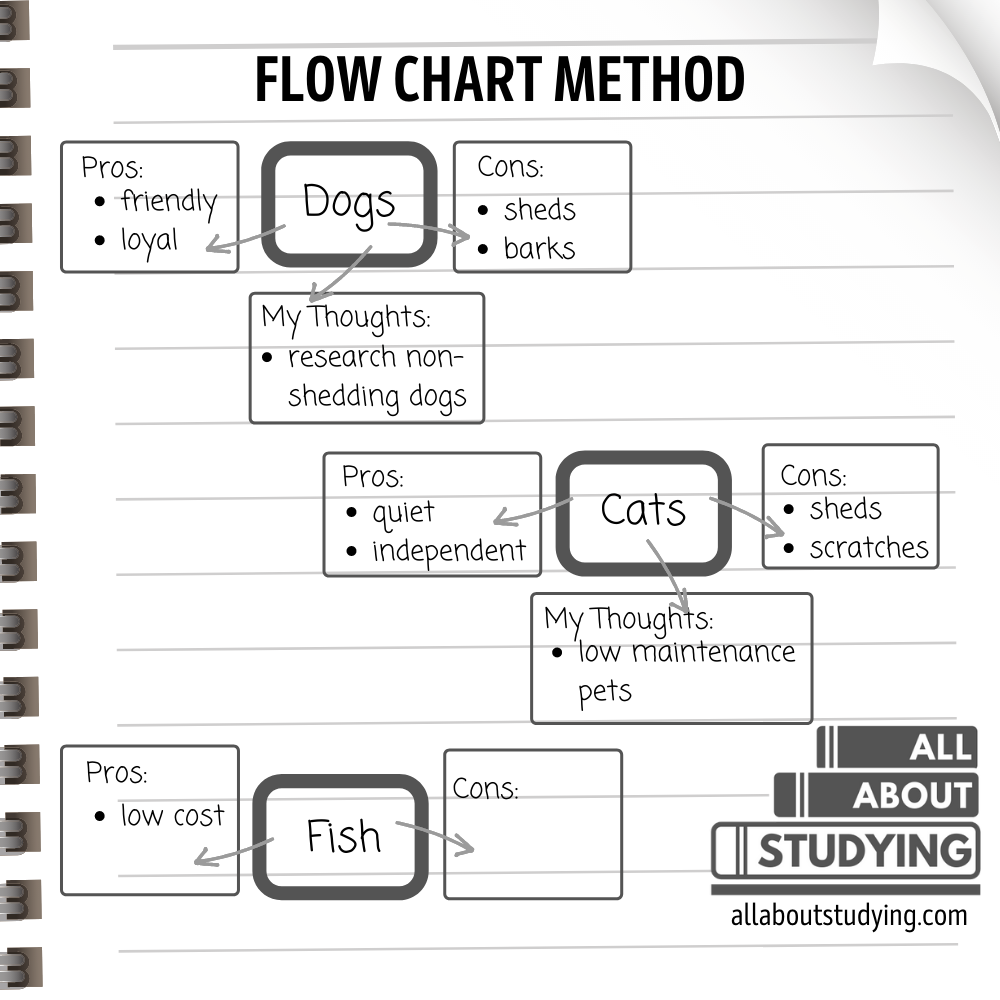
Flow Charts, sometimes called Concept Maps, are a visual representation of the information you're learning. These can take the form of charts, diagrams, tables, and more!
Below is an example of what Flow Chart notes can look like. This form of note taking gives the student a lot of creativity and freedom in how to organize and space out their notes.
The Outline Method is a traditional method of note-taking that many people are likely already familiar with. Outlines will include a bulleted list for each major topic point, and sub-bullets for subtopics. It can be useful for definitions and textbook readings. The video below breaks down some useful tips for using the Outline Method.
Taking good notes is an important part of learning in college. Many of your classes will be in lecture format, where many of your professors will talk for the entirety of the class time. So what are the important parts? What should you be highlighting and writing down? Resources in the column below offer examples of different methods of taking notes and ideal practices for note-taking.
The video below from Crash Course explains the importance of taking notes, what is important to include in your notes, and an overview of some popular note taking methods. The video is around 8 minutes long and has English subtitles.
The animated video below from Well Cast offers tips for taking easy, effective notes. The video is around 5 minutes long and has English subtitles.
 The Sketchnote Handbook
by
This gorgeous, fully illustrated handbook tells the story of sketchnotes--why and how you can use them to capture your thinking visually, remember key information more clearly, and share what you've captured with others. Author Mike Rohde shows you how to incorporate sketchnoting techniques into your note-taking process--regardless of your artistic abilities--to help you better process the information that you are hearing and seeing through drawing, and to actually have fun taking notes. The Sketchnote Handbook explains and illustrates practical sketchnote techniques for taking visual notes at your own pace as well as in real time during meetings and events. Rohde also addresses most people's fear of drawing by showing, step-by-step, how to quickly draw people, faces, type, and simple objects for effective and fast sketchnoting. The book looks like a peek into the author's private sketchnote journal, but it functions like a beginner's guide to sketchnoting with easy-to-follow instructions for drawing out your notes that will leave you itching to attend a meeting just so you can draw about it. Note: This is a Portable Document
The Sketchnote Handbook
by
This gorgeous, fully illustrated handbook tells the story of sketchnotes--why and how you can use them to capture your thinking visually, remember key information more clearly, and share what you've captured with others. Author Mike Rohde shows you how to incorporate sketchnoting techniques into your note-taking process--regardless of your artistic abilities--to help you better process the information that you are hearing and seeing through drawing, and to actually have fun taking notes. The Sketchnote Handbook explains and illustrates practical sketchnote techniques for taking visual notes at your own pace as well as in real time during meetings and events. Rohde also addresses most people's fear of drawing by showing, step-by-step, how to quickly draw people, faces, type, and simple objects for effective and fast sketchnoting. The book looks like a peek into the author's private sketchnote journal, but it functions like a beginner's guide to sketchnoting with easy-to-follow instructions for drawing out your notes that will leave you itching to attend a meeting just so you can draw about it. Note: This is a Portable Document
 Note-Taking for Consecutive Interpreting
by
Note-taking for Consecutive Interpreting: A Short Course is the essential step-by-step guide to the skill of note-taking. The system, made up of a range of tried and tested techniques, is simple to learn, consistent and efficient. Each chapter presents a technique, with examples, tasks and exercises. This second edition has been extensively revised throughout, including: an updated chapter on speech analysis new chapters on comparisons and links revised example speeches and notes a summary of other authors' note-taking guidelines for comparison and reference (Part III). The author uses English throughout - explaining how and where to locate material for other languages - thus providing a sound base for all those working in the areas of conference interpreting and consecutive interpreting in any language combination. This user-friendly guide is a particularly valuable resource for student interpreters, professionals looking to refresh their skills, and interpreter trainers looking for innovative ways of approaching note-taking.
Note-Taking for Consecutive Interpreting
by
Note-taking for Consecutive Interpreting: A Short Course is the essential step-by-step guide to the skill of note-taking. The system, made up of a range of tried and tested techniques, is simple to learn, consistent and efficient. Each chapter presents a technique, with examples, tasks and exercises. This second edition has been extensively revised throughout, including: an updated chapter on speech analysis new chapters on comparisons and links revised example speeches and notes a summary of other authors' note-taking guidelines for comparison and reference (Part III). The author uses English throughout - explaining how and where to locate material for other languages - thus providing a sound base for all those working in the areas of conference interpreting and consecutive interpreting in any language combination. This user-friendly guide is a particularly valuable resource for student interpreters, professionals looking to refresh their skills, and interpreter trainers looking for innovative ways of approaching note-taking.
Procrastination is when you put off doing or working on tasks and projects. Many people deal with it in one form or another, whether it's saying "I'll do it tomorrow" or spending too much time on your phone instead of working. In college, where many of your deadlines will be close to one another or come one right after the other, procrastination can ruin your carefully planned time to work on things. Resources in the column below explain why we procrastinate and how to avoid it.
The animated video below from TED Ed explains what exactly procrastination is and details the psychology behind it and why we do it, even when we don't want to. It is a little over 5 minutes long and has English subtitles.
The video below from Crash Course describes procrastination and offers tips and advice on not only avoiding it, but beating it when it happens. The video is around 10 minutes long and has English subtitles.
Because lo-fi (such as Lofi Beats to Study/Relax To) and binaural beats are so popular for studying music for college students, the video below made by former doctors breaks down the differences between the two genres, and discusses how and why they might actually help you focus better. The video is around 8 minutes long and has auto-generated English subtitles.
 The Procrastination Equation: How to Stop Putting Things Off and Start Getting Things Done
by
Using a mix of psychology, evolutionary biology, self-help, and more than a decade of research, Dr. Piers Steel, the world’s foremost authority on procrastination, offers a tried and true method helping us to identify, understand, and break free of our self-destructive bad habits and create more positive lives for ourselves.
Available as an ebook through SU Libraries.
The Procrastination Equation: How to Stop Putting Things Off and Start Getting Things Done
by
Using a mix of psychology, evolutionary biology, self-help, and more than a decade of research, Dr. Piers Steel, the world’s foremost authority on procrastination, offers a tried and true method helping us to identify, understand, and break free of our self-destructive bad habits and create more positive lives for ourselves.
Available as an ebook through SU Libraries.
 Tiny Habits
by
A habit expert from Stanford University shares his breakthrough method for building habits quickly and easily. With Tiny Habits you'll increase productivity by tapping into positive emotions to create a happier and healthier life. Dr. Fogg's new and extremely practical method picks up where Atomic Habits left off. Based on twenty years of research and Fogg's experience coaching more than 40,000 people, Tiny Habits cracks the code of habit formation. With breakthrough discoveries in every chapter, you'll learn the simplest proven ways to transform your life. Fogg shows you how to feel good about your successes instead of bad about your failures.This proven, step-by-step guide will help you design habits and make them stick through positive emotion and celebrating small successes. Whether you want to lose weight, de-stress, sleep better, or be more productive each day, Tiny Habits makes it easy to achieve--by starting small.
Available as a physical book at Bird Library.
Tiny Habits
by
A habit expert from Stanford University shares his breakthrough method for building habits quickly and easily. With Tiny Habits you'll increase productivity by tapping into positive emotions to create a happier and healthier life. Dr. Fogg's new and extremely practical method picks up where Atomic Habits left off. Based on twenty years of research and Fogg's experience coaching more than 40,000 people, Tiny Habits cracks the code of habit formation. With breakthrough discoveries in every chapter, you'll learn the simplest proven ways to transform your life. Fogg shows you how to feel good about your successes instead of bad about your failures.This proven, step-by-step guide will help you design habits and make them stick through positive emotion and celebrating small successes. Whether you want to lose weight, de-stress, sleep better, or be more productive each day, Tiny Habits makes it easy to achieve--by starting small.
Available as a physical book at Bird Library.
 The Psychology of Effective Studying
by
This book provides a vital guide for students to key study skills that are instrumental in success at university, covering time management, academic reading and note-taking, academic integrity, preparation of written assignments, teamwork and presentations. With each chapter consisting of sub-sections that are titled with a single piece of fundamental advice, this is the perfect 'hit the ground running' resource for students embarking on their undergraduate studies. The book uses evidence from psychology to account for the basic errors that students make when studying, illuminating how they can be addressed simply and effectively. Creating an 'insider's guide' to the core requisite skills of studying at degree level, and using a combination of research and practical examples, the author conveys where students often go fundamentally wrong in their studying practices and provides clear and concise advice on how they can improve. Written in a humorous and irreverent tone, and including illustrations and examples from popular culture, this is the ideal alternative and accessible study skills resource for students at undergraduate level, as well as any reader interested in how to learn more effectively.
Available as an ebook through SU Libraries.
The Psychology of Effective Studying
by
This book provides a vital guide for students to key study skills that are instrumental in success at university, covering time management, academic reading and note-taking, academic integrity, preparation of written assignments, teamwork and presentations. With each chapter consisting of sub-sections that are titled with a single piece of fundamental advice, this is the perfect 'hit the ground running' resource for students embarking on their undergraduate studies. The book uses evidence from psychology to account for the basic errors that students make when studying, illuminating how they can be addressed simply and effectively. Creating an 'insider's guide' to the core requisite skills of studying at degree level, and using a combination of research and practical examples, the author conveys where students often go fundamentally wrong in their studying practices and provides clear and concise advice on how they can improve. Written in a humorous and irreverent tone, and including illustrations and examples from popular culture, this is the ideal alternative and accessible study skills resource for students at undergraduate level, as well as any reader interested in how to learn more effectively.
Available as an ebook through SU Libraries.